

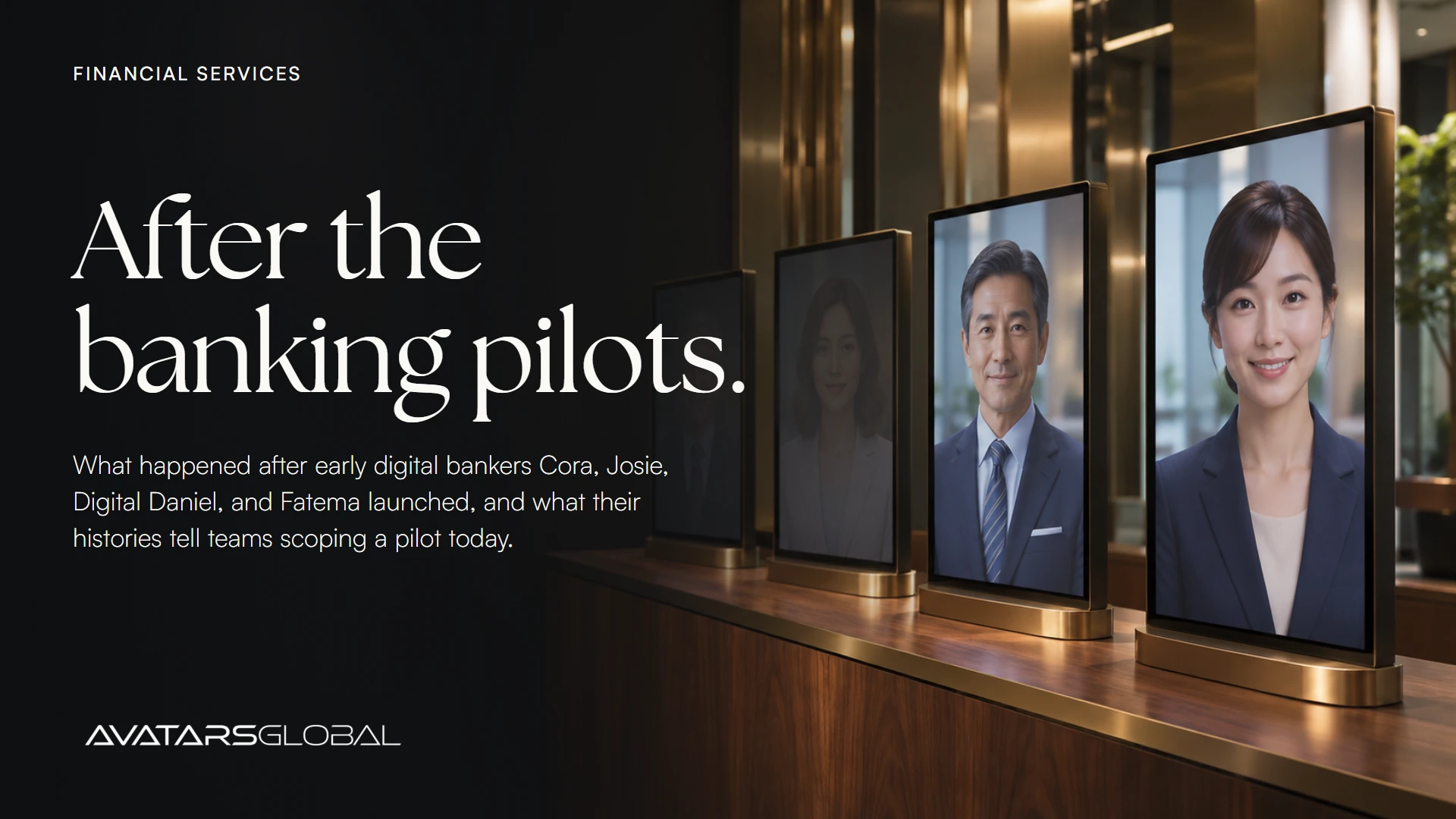
Search for banks using AI avatars and the same small handful of names come up, usually presented as current proof that the category works. Most of them launched within an 18-month window between 2018 and 2019, and almost none of the coverage checks what happened after the launch event. We went back to the original announcements and reporting for four of them. This is what's confirmed today, and what isn't.
NatWest's Cora
Soul Machines built Cora for NatWest Bank. FinTech Futures reported in 2018 that it was in advanced testing, with NatWest saying it would only deploy more broadly if the pilot succeeded. We found nothing published since confirming a full production rollout. A named pilot NatWest took seriously at the time. Current status: unconfirmed.
ASB Bank's Josie
New Zealand's ASB Bank launched Josie, built by fellow New Zealand company UneeQ, in March 2018, billing it as the first human-like interface of its kind in Australasian banking, giving small-business owners startup and account guidance. This is the one example with a current data point, not just launch-era coverage. A November 2025 Spinoff piece on New Zealand's AI assistants shows its author directly asking Josie a question through the ASB app and getting a reply, seven years after launch. Real evidence she's still active in some form, though it reads like a text-based in-app assistant rather than the original 2018 video-avatar tool. The same article confirmed a sibling digital human at another New Zealand retailer, Noel Leeming's in-store "Nola," had been decommissioned earlier that year.
UBS's Digital Daniel Kalt
UBS worked with UneeQ to build a photorealistic digital clone of its own chief economist, Daniel Kalt. Fortune's coverage of the 2018 launch, corroborated by CNBC, describes something narrower than round-the-clock access: the avatar was placed at a single UBS branch in Zurich, meeting roughly 100 clients via a screen in a private meeting room. UBS's own framing was explicit, a test of client acceptance, not a declaration it was replacing anything. A UneeQ case study describing the deployment as 24/7, on-demand access is the vendor's own marketing framing, not what the 2018 launch reporting shows, worth reading as a caution about vendor case studies generally. A 2023 industry piece referenced it as having launched roughly five years earlier, with no update since. Current status: unconfirmed.
Bank ABC's Fatema
Bahrain's Bank ABC announced Fatema, built by Soul Machines, in September 2019, describing it as the world's first "Digital DNA" AI employee in banking. Coverage at launch was substantial. We found no follow-up coverage from 2020 onward confirming Fatema was still operating, or documenting what became of the deployment. Of the four examples here, this is the one that comes closest to a launch announcement with no visible life after it.
The Landscape at a Glance
What's Changed Since These Pilots Launched
One more data point, more concrete than anything above. Soul Machines, the company behind both Cora and Fatema, entered receivership in February 2026, with a sale process underway. Reporting on the receivership describes a company that raised roughly NZ$225 million, shrunk to around 45 staff, and lost both co-founders by mid-2024. Its own site no longer lists case studies for either bank. That doesn't confirm what happened to Cora or Fatema specifically, a vendor's troubles don't automatically mean a deployment was pulled. But it's a more honest answer than treating either as an open question with no evidence either way.
What Four Banks Actually Show
Four different banks, four different builders, within the same 18-month window, and three of the four have no confirmed, current, named source saying they're still operating today, the question this piece set out to check. This category's first wave launched during a specific hype window around digital humans generally, led with a demo of a face that could talk, and generated a burst of press coverage that, in each case we could find, wasn't followed by an update either way. A pilot that quietly ends isn't newsworthy the way a launch is, so silence in the years after tells you less than it seems to.
What We'd Want to See From a Vendor Today
None of this is a complaint specific to Cora, Josie, Digital Daniel Kalt, or Fatema. Soul Machines and UneeQ, the builders behind three of these four, clearly had working technology in 2018, and a first wave of any new category tends to prioritise proving the demo over building the reporting habits that come later. It's a bar any vendor building one of these today, us included, should expect to be held to.
- A status update or case study revisited after year one, not just published at launch and left there.
- A named metric the pilot was measured against from the start, not a launch narrative that never resolves into a number.
- A clear, direct answer on request to whether a deployment is still live, rather than silence standing in for one.
- A decommissioning story told as plainly as the launch story, when a pilot doesn't continue.
What This Means for Scoping One Today
The real takeaway from these four pilots isn't that digital humans don't work in banking. It's that a launch announcement is the least reliable evidence in this category, and that a bank scoping one today should build in what these pilots don't appear to have had from the start: a specific, narrow task the avatar owns end to end, a measurable outcome tied to that task, and a plan for what happens to the pilot, in public, whether it succeeds or gets quietly retired. Soul Machines and UneeQ are both New Zealand companies, and both clearly had the underlying technology working in 2018. What's harder to build, and what even Josie's survival doesn't answer, is the operational discipline that turns a working demo into something measurably useful years on. An in-app assistant carrying the same name isn't proof the original pilot's ambitions were met.
If you're evaluating a vendor's banking digital-human case study, ask the question this piece asked: not whether it launched, but who can confirm it's still running today, and what it's actually measured against.
Full source list
FinTech Futures, "NatWest in AI-driven digital human test," 2018: https://www.fintechfutures.com/ai-in-fintech/natwest-in-ai-driven-digital-human-test
Stuff.co.nz, "Meet Josie, ASB's digital assistant and a New Zealand banking first," 2018: https://www.stuff.co.nz/business/money/101887745/meet-josie-asbs-digital-assistant-and-a-new-zealand-banking-first
The Spinoff, "Why must all our digital AI helpers be ladies?", November 2025: https://thespinoff.co.nz/pop-culture/29-11-2025/why-must-all-our-digital-ai-helpers-be-ladies
Fortune, "UBS Digitally Clones Its Chief Economist Daniel Kalt," July 2018: https://fortune.com/2018/07/05/ubs-digital-clone-chief-economist-daniel-kalt/
CNBC, "Why UBS cloned an economist," July 2018: https://www.cnbc.com/2018/07/19/why-ubs-cloned-an-economist.html
GlobeNewswire, "Bank ABC's AI-powered Digital Employee Fatema, The World's First Digital DNA Human," 2019: https://www.globenewswire.com/news-release/2019/09/11/1914260/0/en/Bank-ABC-s-AI-powered-Digital-Employee-Fatema-The-World-s-First-Digital-DNA-Human.html
b2bnews.co.nz, on Soul Machines entering receivership, February 2026: https://b2bnews.co.nz/news/soul-machines-receivership-225m-raised-12m-left-now-on-the-block/