

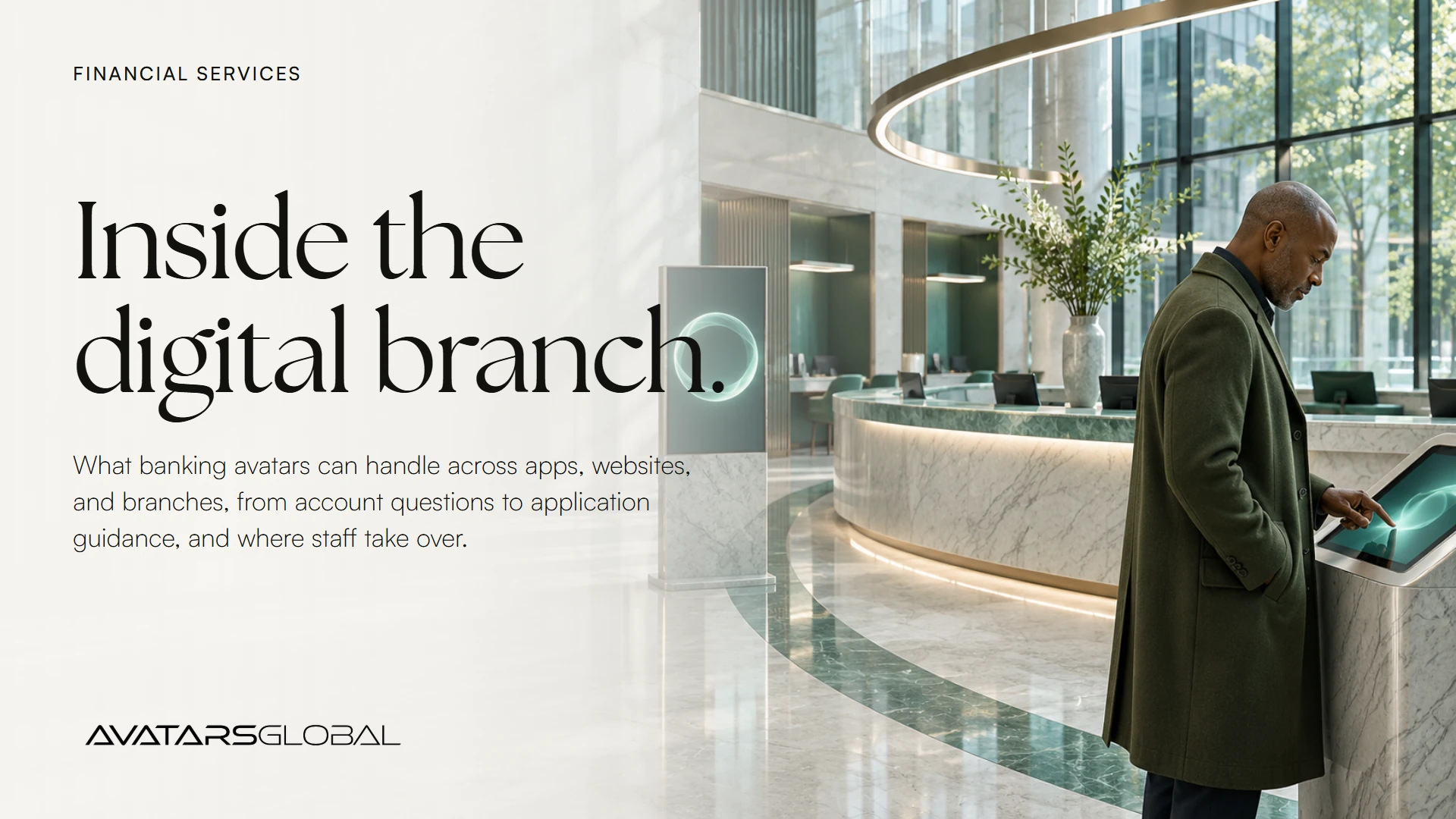
A banking avatar is a conversational AI character that sits inside an app, a website, or a branch kiosk and handles the routine parts of a customer's banking relationship: checking a balance, explaining a fee, walking through a product application, answering "why was this transaction declined" without a hold queue. It doesn't replace a financial advisor or a lending decision. It covers the volume of contact that doesn't need one.
The Earliest Real Attempt at This: NatWest's Cora
Soul Machines built Cora for NatWest Bank, and FinTech Futures' 2018 reporting described it as being in advanced testing, with NatWest saying at the time it would only deploy the technology more broadly if the pilot succeeded. We looked for anything more recent confirming Cora reached a full production rollout and found nothing tying the Soul Machines avatar specifically to a current NatWest product. NatWest did launch a generative-AI upgrade to a separate assistant it also calls Cora in 2024, but that one is described purely as a text-based chatbot, with no mention of Soul Machines or a visual avatar, so it isn't evidence the original pilot progressed. The more concrete update is about the vendor, not the product: Soul Machines itself entered receivership in February 2026, with a sale process underway and both co-founders gone by mid-2024. That doesn't tell you what happened to Cora specifically. It's a more honest answer to 'what happened to this technology' than treating a 2018 test as an ongoing proof of concept.
What a Banking Avatar Is Actually Built to Do
- Answers account questions, balance, recent transactions, why a payment was declined or delayed, in plain language instead of a menu tree.
- Walks a customer through a product application, a new account, a card, a personal loan inquiry, at their own pace, flagging what documentation they'll need before they start.
- Explains a fee, a rate change, or a statement line item on request, the kind of question that generates a disproportionate share of call volume relative to its actual complexity.
- Is available outside branch and call-centre hours, so a question at 9pm doesn't wait until 9am.
- Recognises when a question needs a person, a hardship conversation, a dispute, anything involving real financial risk or judgment, and hands it off rather than guessing.
That last point is the boundary that actually matters. A banking avatar is an information and transaction-support layer. It isn't a financial advisor, and it doesn't make a credit or lending decision. It extends what a bank's existing team can cover across more hours and more volume than branch and call-centre staff alone can handle. A person still makes the calls that carry real financial consequence.
What Stays With a Person, Regardless
That split is also the actual scoping exercise. A bank building this isn't choosing between an avatar and a person. It's deciding, task by task, which side of this table a given interaction belongs on, and building the handoff between them so a customer never has to work out which one they need. Get that split wrong in either direction, an avatar reaching into a judgment call it isn't built for, or a team of people spending their day on procedural volume an avatar could carry, and the cost and trust problems show up quickly on both sides.
Where the Early Pilots Got Ahead of Themselves
Cora and its contemporaries, most of them launched within an 18-month window around 2018, tended to lead with the character rather than the scope: a demo of a face that could talk, without a clearly defined, narrow set of tasks it owned end to end and a clean handoff for everything else. That's a reasonable place to start a pilot. It's a hard place to stop one, since a customer who gets a wrong answer delivered with total confidence on a real account question loses trust faster than one who gets no answer at all.
Getting the Scope Right Before You Build
The place to start is a list, not a character design: pull the call-centre and chat transcripts for the last quarter, sort by volume and by how procedural versus judgment-heavy each question actually is, and find the cluster that's both high-volume and low-judgment. That's the scope an avatar earns its keep on first. An avatar with no clear boundary and no integration into the actual account and transaction systems is a nicer-looking chat widget. One scoped to a specific, high-volume, low-judgment cluster, with a clean handoff for anything else, is what actually reduces call volume instead of adding a new channel to staff.
What to Track If You Pilot This
- Resolution rate within the avatar's defined scope, measured separately from questions it correctly hands off.
- Handoff accuracy: how often it correctly recognises a question it isn't scoped to answer, versus guessing.
- Call and chat volume for the specific question types it's scoped to handle, before and after.
- Customer trust signals, complaint rate and repeat-contact rate, for the scoped interaction type specifically.
Before building anything, pull last quarter's call-centre transcripts and find the single question type that's both highest in volume and lowest in judgment required. That's the one worth scoping first, not the one that makes for the best demo.
Full source list
FinTech Futures, "NatWest in AI-driven digital human test," 2018: https://www.fintechfutures.com/ai-in-fintech/natwest-in-ai-driven-digital-human-test
NatWest Group, "NatWest launches Cora+, the latest generative AI upgrade to the bank's digital assistant," June 2024: https://www.natwestgroup.com/news-and-insights/news-room/press-releases/data-and-technology/2024/jun/natwest-launches-cora-plus-the-latest-generative-ai-upgrade-to-t.html
b2bnews.co.nz, on Soul Machines entering receivership, February 2026: https://b2bnews.co.nz/news/soul-machines-receivership-225m-raised-12m-left-now-on-the-block/